
Construction of Clinic 2: The second basement level is open to the sky
Lead
2026-05-11, 10:00
Sehen Sie in dem Video den aktuellen Bauzustand und erhalten Sie einen Eindruck der Dimensionen im Rohbau.
1. in emergency services for over 20 years - what was your motivation to go into emergency services and what is your motivation to still work there?
Acute illness, a wide range of tasks, being able to break out of the routine and the unpredictable every day - I think these are the things that make the emergency department an interesting place to work.
Of course, not everyone is cut out for emergency work, but once you're enthusiastic about it, you rarely want to change jobs again. Emergency work is strenuous, challenging and requires a high level of stress resistance. If you love variety, this is the right place for you! Working independently, making decisions that require extremely broad knowledge and reacting to new situations at all times is the order of the day here.
I am convinced that we do a very good job in our emergency department, are extremely innovative and support this with research. The cooperation between nursing staff and doctors is also exceptional - we support each other in difficult times. That motivates me every day.
2. what opportunities are there if you want to pursue a career in emergency medicine?
Normally you start with us with some professional experience, and then after about a year you enter the postgraduate course in emergency nursing, which takes two years. This postgraduate course qualifies you for jobs such as shock room or triage. The next step often leads to shift management with day-to-day organizational responsibility. If I am interested in vocational training, I have the opportunity to develop further in this direction. If you have a Bachelor's degree, i.e. a university of applied sciences qualification, a specialist career is open to you.
This year, we have launched a clinical PhD program in the emergency department, which means that both a clinical and an academic career in nursing are open to you.
We have also recently established group management. This gives experienced emergency nurses the opportunity to immerse themselves in management leadership for a period of three years. The group leaders are supported with coaching sessions and receive various further training courses in management - a great opportunity to find out whether this is the right path for you.
3. what can you expect when you complete the NDS Emergency Care with us?
That you learn a lot, but you also have to learn.
As part of the NDS Emergency Nursing, we impart a great deal of knowledge in the field of pathophysiology for an in-depth understanding of various diseases. This prepares you to work very independently in an interprofessional team.
I see that our NDS students undergo great development during their training and become confident, competent emergency care specialists, which is great to see.
4. 20 years at the USB, what makes the USB special as an employer?
I am proud to work at the USB. During my time at the USB, I have received a great deal of support - including financial support - without which I would never have been able to pursue my career. I am very grateful for that.
5 And last but not least: do you sometimes envy your colleagues who work on a ward?
I envy the fact that they can accompany their patients over a longer period of time and thus directly experience their impact. I can initiate a lot here on the emergency ward, but I don't find out much about the outcome.

Der Gebäudekern in Erstellung, in dem später auch die Aufzugsanlagen enthalten sein werden.
Besonders auffällig sind die grossen Betonstützen im Umfeld des Kerns. Zwei davon wurden kürzlich eingebracht. Sie wurden mit einem Spezialverfahren versetzt, da ihr Gewicht von rund zehn Tonnen pro Stück den Einsatz besonderer Hebetechnik erfordert.
Die Stützen verlaufen über mehrere Untergeschosse und übernehmen einen wesentlichen Teil der Gebäudelasten. Zwischen ihnen wird die automatische Transportanalage geführt, die später den internen Transport unterstützt.

Blick vom zweiten Untergeschoss auf die Betonsäulen.
Technik in der Tiefe
Unterhalb des zweiten Untergeschosses befinden sich zwei weitere Ebenen für die Gebäudetechnik. Im dritten Untergeschoss sind die Raumstrukturen für die Elektroanlagen erkennbar. Im vierten Untergeschoss zeigt sich bereits die Dimension der zukünftigen Gebäudetechnik. Hier entstehen die Bereiche für Lüftung und Sanitär, teilweise über zwei Geschosse hinweg organisiert. Diese Ebenen bilden die Grundlage für den gesamten technischen Betrieb des Spitals.

Der aktuelle Stand im vierten Untergeschoss
Baugeschehen vor Ort
Aktuell arbeiten rund sechzig Personen direkt auf dem Baufeld. Ergänzt wird das Team durch weitere Mitarbeitende in den Bürocontainern. Mit dem Fortschritt der Bauarbeiten wird die Anzahl der Beteiligten deutlich steigen. In späteren Bauphasen werden mehrere hundert Personen gleichzeitig auf der Baustelle tätig sein.
Erschliessung an das City Parking
Auf dieser Ebene ist der spätere Zugang zum City Parking bereits angelegt. Der Rohbau macht die Verbindung zum Spital heute schon räumlich sichtbar. Hier werden später Personen aus dem City Parking ins Spital gelangen und von dort weiter ins Gebäude geführt.
Dort, wo später gearbeitet wird
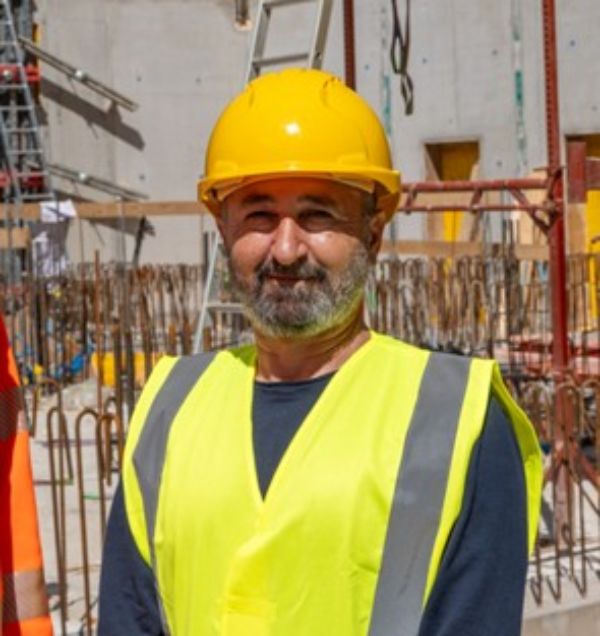
Die Baustelle ist noch nicht fertig und ich stehe jetzt schon an dem Ort, an dem ich später arbeiten werde. Wenn alles fertig ist, werde ich das hier jeden Tag erleben. Das ist ein tolles Gefühl.
Mehmet Ördek, Leiter Spezialreinigung