Annual report 2025
Investment in personnel is particularly important in difficult times
Das Universitätsspital Basel (USB) ist finanziell auf Kurs: Der Konzerngewinn steigt im Berichtsjahr auf 6.6 Millionen Franken. Der Kauf des Claraspitals, der Neubau des Klinikums 2 und die Digitalisierung werden die Zukunft des USB prägen.
Kennzahlen 2025
USB
44'060
stationäre Patientinnen und Patienten
8'225
Mitarbeitende
Konzern
1,6
CHF Mrd. Umsatz
7,2 %
EBITDAR-Marge
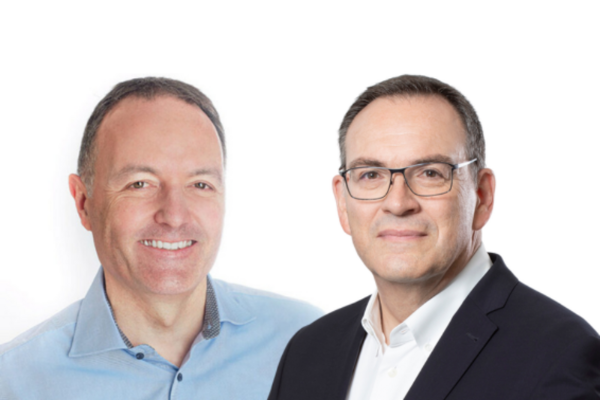
Interview with Chairman of the Board of Directors Robert-Jan Bumbacher and Director Werner Kübler

A year ago, the USB was still able to report a profit, but now the result is a significant loss. How did this come about?
Bumbacher: This is largely due to the general economic climate, particularly in the healthcare sector, and even more specifically in the large central and university hospitals. In contrast to most other comparable hospitals, the University Hospital Basel was still able to remain in the profit zone in the previous year. However, the USB also suffered a significant loss in the 2023 reporting year. This was mainly due to a combination of various factors, such as insufficient financial compensation for our services and the sharp rise in prices in all areas, such as medical supplies, electricity and wage costs.
Kübler: There are also internal factors. After the pandemic, we are once again seeing pronounced seasonal fluctuations in patient volumes, which was hardly the case before. Added to this is the shortage of specialist staff. These circumstances make capacity planning more challenging. We have taken measures to deal with these challenges and are joining forces to implement them. This means that we use our resources as economically and effectively as possible and continuously improve our processes. Our employees are the most important factor here: They do an excellent job.

Robert-Jan Bumbacher, Chairman of the Board of Directors USB
«Ob ambulant oder stationär – das USB ist für die Menschen in der Nordwestschweiz das Spital der Wahl. Auch wirtschaftlich war der Spitalbetrieb 2025 erfolgreich; dies ist wichtig, um die anstehenden Investitionen zu finanzieren.»
Nevertheless, the USB continues to invest in staff, digitalization and the building infrastructure. How do you explain this?
Bumbacher: The USB has a clear mission: to ensure that the city, the region and its population are provided with excellent quality healthcare services in the long term. As a strong backbone of the regional healthcare system, the USB has a responsibility to invest in basic care, maximum care, cutting-edge medicine, training and research at the right time.
Kübler: We are also guided by practical necessities: Medicine is developing at an incredible pace. We have to regularly update our infrastructure, be it digital or structural. The fact that more and more services can be offered on an outpatient basis does not mean that a university hospital needs far fewer inpatient beds, for example. But it does mean that our processes are constantly changing. This has an impact on our staff, in whom we are constantly investing to keep working conditions attractive.
«2026 steht im Zeichen der Integration des Claraspitals ins USB und der Transformation an beiden Standorten. (...) Ich freue mich sehr über die grosse Offenheit unserer Mitarbeitenden auf beiden Seiten des Rheins, diesen Weg gemeinsam zu gehen und sich für die Medizin der Zukunft zu engagieren.»

Robert-Jan Bumbacher, Chairman of the Board of Directors USB
If we stay with personnel: The USB, like the entire industry, is struggling for skilled workers. What are we doing here?
Bumbacher: Despite the financial situation, we are consciously investing in staff. Being an attractive employer is essential in order to be able to provide services for patients around the clock. We have once again granted the cost-of-living adjustment and made targeted investments in attractive working conditions, both for nursing staff and for assistant and senior physicians.
Kübler: For these professional groups in the hospital's core business in particular, it's not "just" about pay. Investment in working conditions is just as important. These include, in particular, the compatibility of work and family, training and further education, and the organization of shift and on-call duty. For the hospital, this is associated with organizational as well as economic challenges. It also needs the support of politicians and society. Ultimately, the question is: how much is a well-functioning healthcare system in which people enjoy working worth to us?
The pandemic has been declared over, but the USB is still seeing record numbers of patients. Why is this?
Kübler: We are seeing this phenomenon throughout the hospital sector. Patient numbers are rising and there are a number of reasons for this. On the one hand, it is certainly the demographic trend: we are getting older and older and the baby boomers are now at an age where they have a whole range of age-related illnesses. On the other hand, medical progress means that we have effective treatment options for more and more diseases. The centers are disproportionately affected by these developments, as this is where these patient flows come together.
Bumbacher: We should not forget: This trend is clear proof that we are doing an excellent job at the USB. It shows very clearly that the USB is the backbone of healthcare in Northwestern Switzerland. I would like to express my thanks to all employees for this outstanding work.
News from the USB




.jpg/jcr:content/2026-02-13_Grundsteinlegung%20K2%20(2).jpg)

.jpg/jcr:content/Website%20Bild.png)



The Board of Directors
The Board of Directors is the supreme management body of the company. The Board of Directors constitutes itself. The election of the Chairman by the Government Council is reserved. The Board of Directors delegates the management of the company in its entirety to the hospital management, unless the law or the organizational regulations provide otherwise. The Board of Directors is responsible for the overall management, supervision and control of the management.